Ask Your Station, the API
Your station answers questions over HTTP: the vessels it hears, their tracks, port calls and events, as JSON. Any program that can fetch a web address can read them.
You need: AIS-catcher receiving ships.
Switch the API on
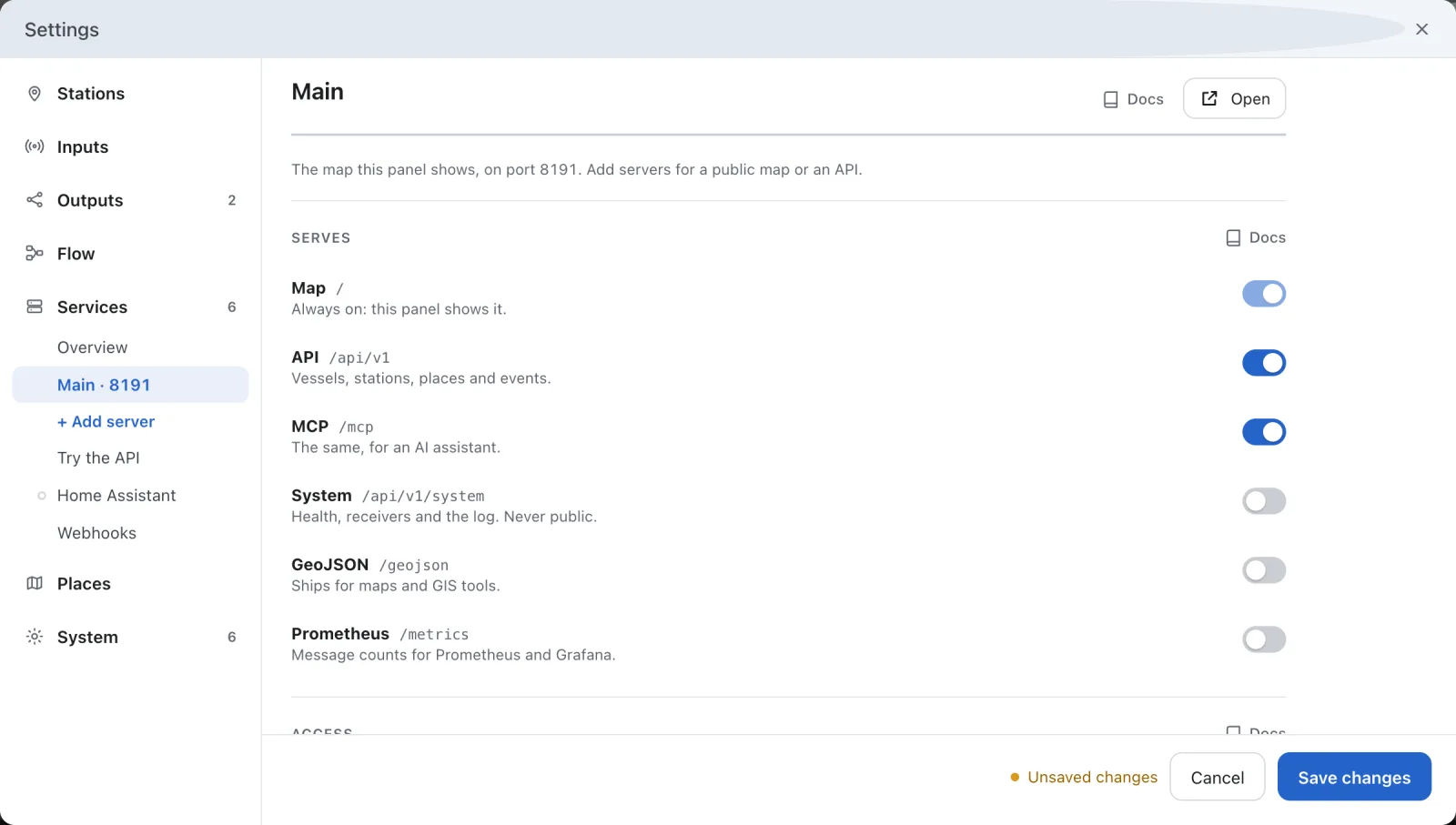
In the dashboard, open Settings → Services → Main. Main is the server that serves the dashboard's map, on the port after the dashboard's: 8119 unless you changed it.
Under Serves, switch API on and press Save changes. The server serves it at once.
Dashboard open to your network?
Then Main is too, and its Access section asks who may read the API. Press New key to make a key, or choose Open to let everyone on the network read it.
Add "api": true to the server entry of the web viewer, or add an entry:
{
  "config": "aiscatcher",
  "version": 1,
  "server": [
    { "port": 8100, "api": true }
  ]
}
| Key | What it does |
|---|---|
port |
The server's port. |
api |
Serves the API under /api/v1. |
Then restart AIS-catcher with the file:
AIS-catcher -C config.json
Map open to your network?
A server with the API and no keys listens on this computer alone, and the map with it: the log says so. To keep the map open, give the API a server of its own: { "port": 8101, "ui": false, "api": true } beside the map's { "port": 8100 }.
Add -N with a port and api on to the command you already use. If it has a -N already, add api on after it:
AIS-catcher -N 8100 api on
Map open to your network?
A server with the API and no keys listens on this computer alone, and the map with it: the log says so. To keep the map open, give the API a server of its own: AIS-catcher -N 8100 -N 8101 ui off api on.
Try it
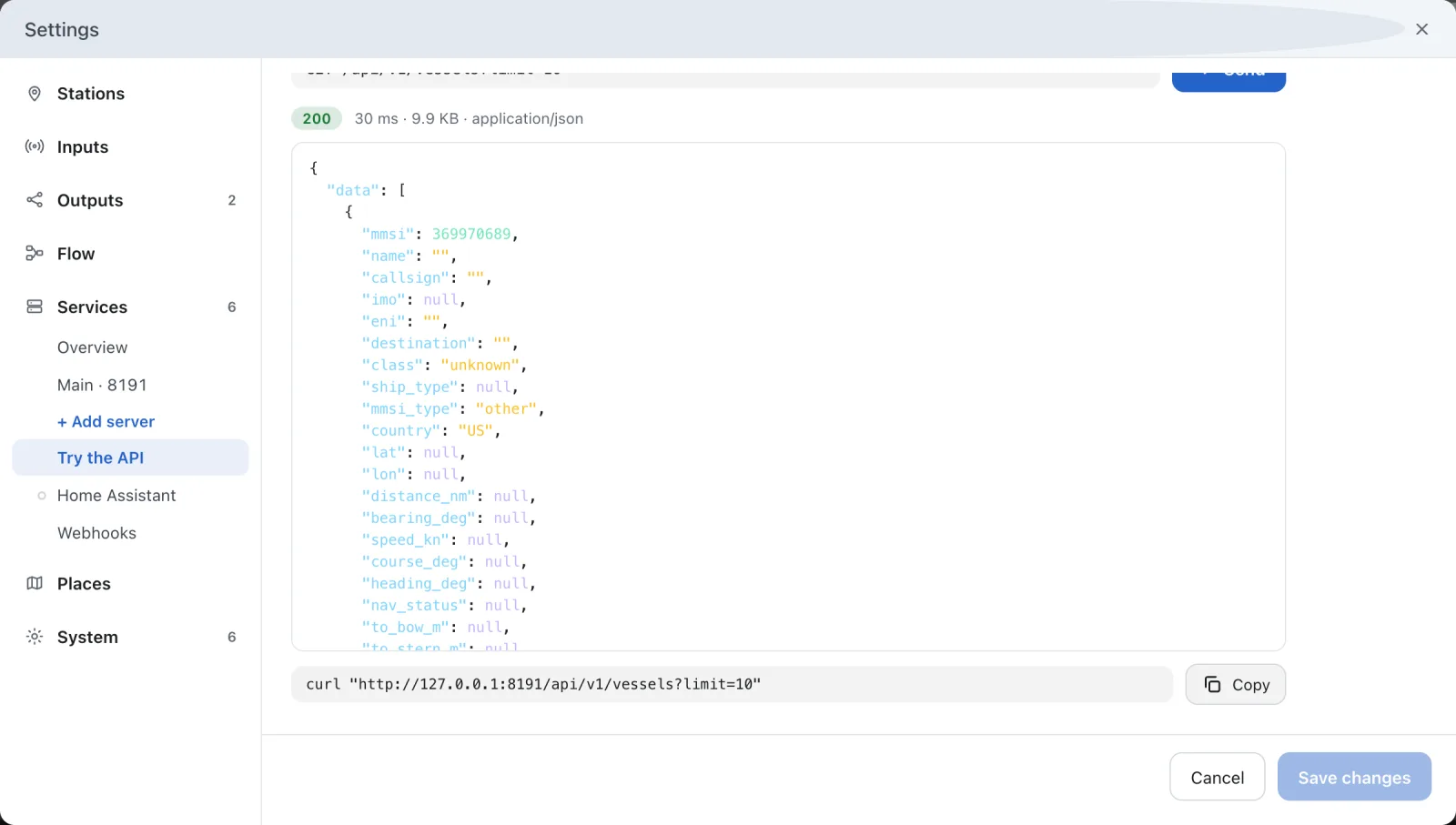
At the top of Main's page, press Try the API. Pick an Endpoint, such as /api/v1/vessels, and press Send. The answer appears below it, with the curl line that repeats the request.
Try the API is part of the dashboard, which only managed mode has. A browser shows the answers too: on the computer that runs AIS-catcher, open http://127.0.0.1:8100/api/v1. The answer lists what the API offers, such as /api/v1/vessels.
Try the API is part of the dashboard, which only managed mode has. A browser shows the answers too: on the computer that runs AIS-catcher, open http://127.0.0.1:8100/api/v1. The answer lists what the API offers, such as /api/v1/vessels.
Ask from a program
On the computer that runs AIS-catcher, send the same request from a terminal:
curl "http://127.0.0.1:8119/api/v1/vessels?limit=10"
On the computer that runs AIS-catcher, send a request from a terminal:
curl "http://127.0.0.1:8100/api/v1/vessels?limit=10"
On the computer that runs AIS-catcher, send a request from a terminal:
curl "http://127.0.0.1:8100/api/v1/vessels?limit=10"
The answer is {"data": [ ... ], "meta": { ... }}, with one vessel in each row of data.
Reach it from another computer
To let programs on other computers ask, give them a server of their own. Under Settings → Services, press + Add server. The new server has the API switched on and its own Port.
Set Listens on to Network. Under Access, keep Keys and press New key. Name the key, press Make key and copy it: it is shown once. Then press Save changes.
To let programs on other computers ask, give them a server of their own, with a key. AIS-catcher -K prints a new key and its SHA-256. Give the key to the program. The file holds only the SHA-256:
{
  "config": "aiscatcher",
  "version": 1,
  "server": [
    { "port": 8100, "api": true },
    { "port": 8110, "api": true,
      "keys": [ { "name": "laptop", "sha256": "<sha256>", "scopes": ["data"] } ] }
  ]
}
| Key | What it does |
|---|---|
keys |
The keys the server takes, each with a name, the sha256 of the key and its scopes. |
A server with keys listens on the network. Restart AIS-catcher with the file.
To let everyone on the network read it without a key, write "public": true in place of keys.
To let programs on other computers ask, give them a server of their own, with a key. AIS-catcher -K prints a new key and its SHA-256. Give the key to the program, and add a -N with the SHA-256 to your command:
AIS-catcher -N 8100 api on -N 8110 api on keys laptop:data:<sha256>
keys takes the key's name, its scopes and its SHA-256, separated by colons. A server with keys listens on the network.
To let everyone on the network read it without a key, write public on in place of keys and its value.
A program sends the key with every request, to the server's own port:
curl -H "Authorization: Bearer $KEY" "http://station.local:8110/api/v1/vessels?limit=10"
What next
- API explains the lists, the filters and the keys. The API reference lists every route and field.
- Let an AI Assistant Read Your Station offers the same data to an assistant.